

Basic Omelet
Difficulty 3/5 Ingredients 21 Steps 18
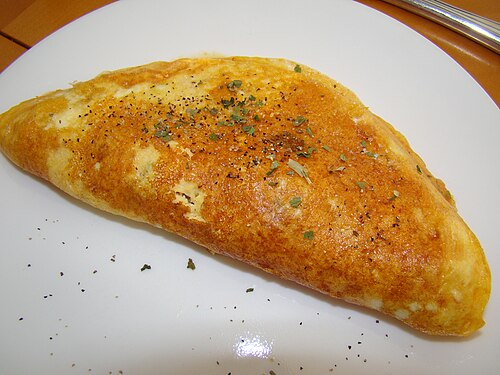
An omelet or omelette is a breakfast food consisting of an egg-based wrapper around a filling of your choice. Omelettes take little time to complete. Always ensure your fillings are either pre-cooked, able to be finished in the time available, or edible when raw but warmed.
Ingredients
Omelet base
- 2 eggs and 2 egg whites for a typical (6-inch/15 cm) pan
- oil
Fillings (suggested)
- Pre-cooked bacon
- Broccoli or most other seasonal vegetables
- Black olives
- Chopped tomatoes, optionally with the seeds and pulp removed
- Pan-fried garlic, mushrooms, and fennel
- Zucchini and leeks
- Cheese, e.g. cheddar, Pecorino Romano, goat's chevre and fresh herbs (e.g. basil)
- Any blue cheese
- Spinach, goat cheese, and pinenuts
- Sautéed spinach
- Pancetta
- Wood-fired or lightly roasted baby potatoes and fresh herbs
- Wood-fired baby potatoes, mushrooms, and Brie
- Spanish sausage, mushrooms, and blue cheese
- Smoked salmon, crispy potatoes and herb sour cream
- Smoked salmon, Brie, and fresh herbs
- Prawns and Brie with fennel confit
- Pancetta, bocconcini, and basil
- Feta cheese, garlic, and cheddar cheese
Steps
If you only have a normal frying pan
- Chop filling.
- Mix eggs well. Thin with milk if desired, up to 1 Tbsp per egg.
- Pour eggs into cool (room temperature) frying pan.
- Heat pan, stirring constantly.
- Stop stirring as soon as solid egg begins to form.
- As egg solidifies, pry loose around edges.
- If top will not solidify, pry up an edge and tilt pan to let liquid egg flow under.
- Keep loosening egg from edges until it slides around.
- Flip egg without ripping it, using very wide turner (or two smaller ones). Or flip in the air: move pan rapidly away, then up, back a bit, then rapidly down. Catch egg in pan.
- Place filling on egg.
- When egg is done, wrap around filling. Serve.
If you have a large flat professional-style cooktop
- Chop filling.
- Mix eggs well. Thin with milk or cream if desired.
- Heat griddle directly on cooktop, without a pan.
- Pour eggs onto griddle in spiral motion, spreading wide and thin.
- When egg has set, add fillings on top gently.
- Fold egg over filling with large turner (3 x 12-inch, or 75 x 300 mm).
- When bottom is cooked, flip omelette to cook other side.
Notes from the original
- Before non-stick coating became common, many cooks would keep a special omelette pan which would not be used for any other purpose. It is important to use a very clean pan, especially if it is not a "non-stick" pan. If keeping a pan solely for omelettes, after cooking, wipe well with a clean cloth or paper-towel and then apply a thin coating of clean vegetable oil.
- You can use 3 eggs and a dash of milk or cream instead of the 2 eggs and 2 egg whites.
- Try frying the omelette in butter.
- After folding the omelette, you can top with grated cheddar and place frying pan under a grill until the cheese begins to brown.
- You can garnish with cream cheese, sour cream, or other thickened dairy product along with a fragrant sprig of a fresh herb or edible flower.
- Try frying the omelet in excess oil and butter (covering the top).
Source. Adapted from “Cookbook:Basic Omelet” by Wikibooks contributors, revision of 2025-06-21, licensed under CC BY-SA 4.0.
Changes. Steps rewritten into short commands. Introduction shortened. Wiki formatting removed. This adapted recipe is shared under CC BY-SA 4.0.
Photo. Omelet With Fixings.jpg by Stripey the crab, CC BY-SA 3.0, via Wikimedia. Resized; otherwise unchanged.