




Cabbage Kimchi
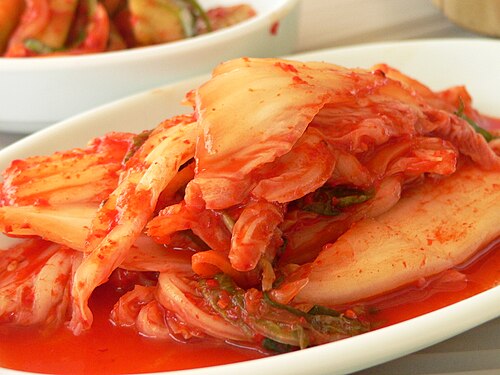
Kimchi (김치), also spelled kimchee or gimchi, is a Korean dish of pickled vegetables, usually napa cabbage or Korean radish and is commonly served as a side dish. It is usually fermented in a brine of anchovy sauce, ginger, garlic, green onion, and chilli pepper. There are countless varieties—at least as many as there are households. The following is a standard recipe for baechoo kimchi (napa-cabbage kimchi), a…
Ingredients
- 1 head napa cabbage (baechu, Chinese cabbage, wombok)
- ½ cup sea salt (or any coarse salt)
- 1 cup water
- 2 tbsp minced garlic
- 1 tsp minced ginger
- ½ cup gochugaru (Korean chile flakes)
- 2 tsp salt
- 1 tbsp sugar
- ¼ cup aekjeot (Korean fish sauce)
- ½ onion, thinly sliced
- ¼ carrot, thinly julienned
- ¼ Korean radish (muwoo), thinly julienned
- 4 green onions, cut into 3-cm pieces
Steps
- Quarter napa cabbage. Wash. Drain.
- Combine coarse sea salt and water.
- Put cabbages in salted water. Take out one at a time to get salt down.
- Add cabbages to container. Pour salted water over. Set aside at least 6–8 hours, overnight is good, until cabbage is soft enough to bend.
- Wash cabbages. Drain well.
- Combine gochugaru, salt, sugar, jeot gal (Korean fish sauce), minced garlic and minced ginger.
- Mix onion, carrot, radish and green onion into chilli powder mixture.
- Stuff mixture between every layer of one cabbage.
- Fold cabbage in half. Wrap securely with 2 outer leaves.
- Put cabbages in airtight container. Sit at room temperature overnight.
- Refrigerate at least 2–3 days. Liquid appearing is normal and means kimchi is ripening.
Notes from the original
- Korean radishes are large (about ½ to 1 kilogram). Japanese (daikon) radishes or a larger quantity of small European radishes could substitute.
- The brine can be varied to include many other ingredients. Be creative.
- The aekjeot can be replaced with moderate amounts of saeujeot (Korean salted tiny shrimp), raw butterfish, or raw oysters. Seafood can also be left out entirely, although an appropriate amount of salt needs to be added in place of missing jeot gal. Alternative flavors can include Asian pears or tangerines.
Source. Adapted from “Cookbook:Cabbage Kimchi” by Wikibooks contributors, revision of 2026-04-12, licensed under CC BY-SA 4.0.
Changes. Steps rewritten into short commands. Introduction shortened. Wiki formatting removed. This adapted recipe is shared under CC BY-SA 4.0.
Photo. Gimchi.jpg by Nagyman, a flickr user, CC BY-SA 2.0, via Wikimedia. Resized; otherwise unchanged.