


← Daily Bread

Privacy

Daily Bread has no accounts of its own. The website is a portal to recipes that live in your own cloud account; your recipes, photos and lists are never sent to us. The one thing kept on Daily Bread's side is the star ratings people give Explore recipes, described below.

What stays in your browser

Recipe ratings

When you rate an Explore recipe, the page sends your rating to Daily Bread's ratings service together with your Apple or Google sign-in token. The service uses the token once, to ask Apple or Google which account it belongs to, and never keeps or logs it. It then stores only the rating (1 to 5 stars) and the recipe, under a scrambled one-way code made from your account identifier, so one account counts once per recipe and you can change or clear your rating. No name, email address or recipe of yours is stored. Everyone sees each recipe's average and number of ratings, never who gave them. Ratings are kept on Netlify, which hosts the site.

Continue with Apple

Sign-in goes through Apple's CloudKit JS. Your recipes are read from and written to the private database of your own iCloud account, the same one the Daily Bread iPhone app uses. Apple shares no name or email address with the website; it sees only an anonymous record identifier.

Continue with Google

Sign-in goes through Google Identity Services. The website asks for one permission, access to its own hidden app-data folder in your Google Drive, and stores your library there as a file no other app can see. The access token lives in memory only and is revoked when you sign out.

Browse without signing in

The demo runs on sample recipes held in memory. Nothing is saved.

Diagnostics

If something goes wrong, the page keeps a short in-memory list of error categories, with addresses, tokens and email addresses removed. You can export it from Settings to send along with a question. It never leaves your browser on its own.

Questions: support@dailybreadrecipe.com

← Daily Bread

Terms of Service

Daily Bread is a recipe collection app for iPhone and the web, made by its developer and offered free of charge. These terms are short because the service is simple: there is no account of ours and no payment, and your recipes stay in your own cloud.

The service

The website at dailybreadrecipe.com and the Daily Bread app let you write recipes, save recipes from web pages, convert measurements and make shopping lists. Your recipes are stored in your own browser and, when you sign in, in your own iCloud or Google Drive account. We do not operate a database of your recipes and cannot see, restore or move them. The only thing we keep is the star ratings people give Explore recipes, as described in the privacy policy.

Your account with Apple or Google

Signing in uses your existing Apple ID or Google account under their own terms. Daily Bread receives only what those services provide to a web app: an anonymous record identifier from Apple, or permission to a hidden app folder from Google. You can revoke that permission at any time in your Apple ID or Google Account settings, and Sign Out in Daily Bread removes the browser's copy.

Your content

Recipes, photos and lists you keep in Daily Bread are yours. You are responsible for having the right to save content you import from other websites, and for respecting the terms of the sites you visit through Discover. Daily Bread does not publish, share or license your content.

Explore Recipes

The recipes in Explore Recipes are adapted from the Wikibooks Cookbook, written by Wikibooks contributors and licensed under CC BY-SA 4.0. Daily Bread rewrote their steps and shortened their introductions; the adapted recipes are shared under the same licence, which lets you copy, change and share them as long as you credit the source and keep the licence. Each recipe names its source, its authors and the exact revision used, and each saved copy keeps that credit in its notes. Photos come from Wikimedia and keep their own licences, credited on each recipe. Daily Bread is not affiliated with or endorsed by Wikibooks or the Wikimedia Foundation.

Ratings

Signed-in people can rate Explore recipes from 1 to 5 stars, once per recipe, and change or clear their rating at any time. Averages and counts are shown to everyone. Ratings that look automated or abusive may be removed.

Acceptable use

Use the service for personal, lawful purposes. Do not attempt to interfere with the site, probe it for weaknesses, or use it to send unsolicited messages or distribute harmful content.

No warranty

The service is provided as is, without warranties of any kind. Sync depends on Apple's and Google's services, your network and your browser, and may be interrupted. Keep your own backups: Settings → Backup exports every recipe and list to a file. To the extent permitted by law, the developer is not liable for lost content or any indirect damages arising from use of the service.

Changes and termination

The service may change or end at any time. Because your content lives in your own cloud and can be exported, you keep it regardless. These terms may be updated; the current version is always at dailybreadrecipe.com/terms.

Privacy

How the site handles data is described in the privacy policy.

Last updated 2 November 2026 · Questions: support@dailybreadrecipe.com

← Daily Bread

Support

Questions, a recipe that will not import, or sync that looks stuck? Write to us and a person will answer, usually within two working days.

support@dailybreadrecipe.com

What helps us help you

Common questions

My recipes are not showing up. Sign in with the same Apple ID or Google account you used before, then choose Sync Now in Settings. Recipes saved with Apple appear in the iPhone app and on the website; recipes saved with Google appear only on the website.

How do I keep a copy? Settings → Backup exports every recipe and list to a file.

How do I delete my data? Your recipes live in your own iCloud or Google Drive, not with us. Delete them in the app, or remove Daily Bread's access in your Apple ID or Google Account settings. Sign Out removes this browser's copy.

See also the privacy policy and terms of service.

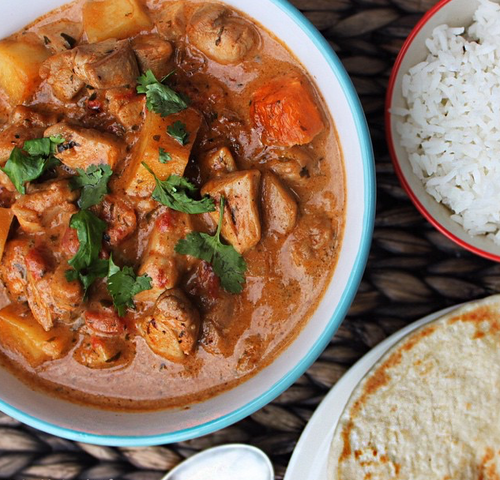
Chicken Vindaloo

Serves 4 Time 1 hour Difficulty 3/5 Ingredients 15 Steps 19

Chicken Vindaloo

Vindaloo is a hot and spicy dish from the Goa region of India. Its heavy use of vinegar and the traditional meat of pork are due to the Portuguese influence on the area. Vindaloo is a popular Indian restaurant meal, where it is often made with pork, beef, chicken, lamb, prawns, or vegetables such as mushrooms.

Ingredients

  • 3 chicken breast fillets
  • 2–3 large onions
  • 2 fresh chile peppers (any color)
  • 6 cloves of garlic (or 6 tsp minced)
  • 2 cm cube of fresh ginger
  • 1 tsp turmeric
  • 2 tbsp white wine vinegar
  • 1 tsp dried coriander powder
  • 1 tsp garam masala
  • ½ tsp cinnamon powder
  • 1½ tsp black peppercorns
  • 1 tsp black mustard seeds
  • ½ tsp rock salt
  • 1 tbsp chopped fresh coriander leaves
  • ½ cup water

Steps

Make the onion sauce

  1. Pour enough vegetable oil into thick-based frying pan to cover base with a little excess. Heat on stovetop.
  2. Slice onions into thin slivers. Add to very hot oil.
  3. Turn heat to low. Sauté gently; after around 3 minutes they should start to caramelize.
  4. Gradually turn up heat. Stir continually until heavily browned without burning.
  5. Add white wine vinegar. Keep stirring until it evaporates. Fry several more minutes until very brown, not burnt.
  6. Remove onions to bowl, letting as much oil as possible drip back into pan.
  7. Put onions in blender or food processor with around 1 tablespoon oil. Process around 1 minute into fairly thick, dark brown sauce.
  8. Remove sauce from blender. Set aside.

Make the garlic/chili paste

  1. Coarsely chop garlic cloves (and ginger if using). De-seed chili peppers and chop likewise. Add garlic and chillies to food processor.
  2. Blend into fairly grainy, liquid sauce.
  3. Add turmeric, coriander powder, garam masala and cinnamon. Stir until well mixed. Set aside.
  4. Crush black peppercorns in mortar and pestle until coarse. Add mustard seed and rock salt. Continue until all spices form coarse powder.

Cook the paste and meat

  1. Pour a little oil into saucepan. Add spiced garlic and chili paste, slightly floating on oil, not touching pan bottom.
  2. When sauce is hot and bubbling, add chopped meat. Stir until meat absorbs spice mix and is browned and mostly cooked.

Add onion sauce and simmer

  1. Add onion sauce. Stir 1 minute. Add a little water. Stir 2 minutes. Turn heat quite low. Sauce should be quite runny and orange/tan.
  2. Add vegetables if desired, such as half a cup of frozen peas.
  3. Cover. Cook around 30-40 minutes. Stir every 5 or 10 minutes to prevent sticking or burning.
  4. In last 15 minutes, boil 2 cups pilau or basmati rice in a pan.
  5. Spoon curry over rice. Sprinkle with chopped coriander leaves. Serve immediately.

Notes from the original

  • Powdered or dried ingredients can be substituted for fresh, but at the expense of taste.
  • If you don't have fresh ginger use 2 cloves garlic + 1 tsp dried ginger powder.
  • Double the amount of each of these ingredients:
  • chosen chilies (if you like very spicy curry)
  • garlic
  • ginger

Source. Adapted from “Cookbook:Chicken Vindaloo” by Wikibooks contributors, revision of 2026-02-03, licensed under CC BY-SA 4.0.

Changes. Steps rewritten into short commands. Introduction shortened. Wiki formatting removed. This adapted recipe is shared under CC BY-SA 4.0.

Photo. Chicken Vindaloo.jpeg by Carpathia at English Wikibooks, Public domain, via Wikimedia. Resized; otherwise unchanged.