



← Daily Bread

Privacy

Daily Bread has no accounts of its own. The website is a portal to recipes that live in your own cloud account; your recipes, photos and lists are never sent to us. The one thing kept on Daily Bread's side is the star ratings people give Explore recipes, described below.

What stays in your browser

Recipe ratings

When you rate an Explore recipe, the page sends your rating to Daily Bread's ratings service together with your Apple or Google sign-in token. The service uses the token once, to ask Apple or Google which account it belongs to, and never keeps or logs it. It then stores only the rating (1 to 5 stars) and the recipe, under a scrambled one-way code made from your account identifier, so one account counts once per recipe and you can change or clear your rating. No name, email address or recipe of yours is stored. Everyone sees each recipe's average and number of ratings, never who gave them. Ratings are kept on Netlify, which hosts the site.

Continue with Apple

Sign-in goes through Apple's CloudKit JS. Your recipes are read from and written to the private database of your own iCloud account, the same one the Daily Bread iPhone app uses. Apple shares no name or email address with the website; it sees only an anonymous record identifier.

Continue with Google

Sign-in goes through Google Identity Services. The website asks for one permission, access to its own hidden app-data folder in your Google Drive, and stores your library there as a file no other app can see. The access token lives in memory only and is revoked when you sign out.

Browse without signing in

The demo runs on sample recipes held in memory. Nothing is saved.

Diagnostics

If something goes wrong, the page keeps a short in-memory list of error categories, with addresses, tokens and email addresses removed. You can export it from Settings to send along with a question. It never leaves your browser on its own.

Questions: support@dailybreadrecipe.com

← Daily Bread

Terms of Service

Daily Bread is a recipe collection app for iPhone and the web, made by its developer and offered free of charge. These terms are short because the service is simple: there is no account of ours and no payment, and your recipes stay in your own cloud.

The service

The website at dailybreadrecipe.com and the Daily Bread app let you write recipes, save recipes from web pages, convert measurements and make shopping lists. Your recipes are stored in your own browser and, when you sign in, in your own iCloud or Google Drive account. We do not operate a database of your recipes and cannot see, restore or move them. The only thing we keep is the star ratings people give Explore recipes, as described in the privacy policy.

Your account with Apple or Google

Signing in uses your existing Apple ID or Google account under their own terms. Daily Bread receives only what those services provide to a web app: an anonymous record identifier from Apple, or permission to a hidden app folder from Google. You can revoke that permission at any time in your Apple ID or Google Account settings, and Sign Out in Daily Bread removes the browser's copy.

Your content

Recipes, photos and lists you keep in Daily Bread are yours. You are responsible for having the right to save content you import from other websites, and for respecting the terms of the sites you visit through Discover. Daily Bread does not publish, share or license your content.

Explore Recipes

The recipes in Explore Recipes are adapted from the Wikibooks Cookbook, written by Wikibooks contributors and licensed under CC BY-SA 4.0. Daily Bread rewrote their steps and shortened their introductions; the adapted recipes are shared under the same licence, which lets you copy, change and share them as long as you credit the source and keep the licence. Each recipe names its source, its authors and the exact revision used, and each saved copy keeps that credit in its notes. Photos come from Wikimedia and keep their own licences, credited on each recipe. Daily Bread is not affiliated with or endorsed by Wikibooks or the Wikimedia Foundation.

Ratings

Signed-in people can rate Explore recipes from 1 to 5 stars, once per recipe, and change or clear their rating at any time. Averages and counts are shown to everyone. Ratings that look automated or abusive may be removed.

Acceptable use

Use the service for personal, lawful purposes. Do not attempt to interfere with the site, probe it for weaknesses, or use it to send unsolicited messages or distribute harmful content.

No warranty

The service is provided as is, without warranties of any kind. Sync depends on Apple's and Google's services, your network and your browser, and may be interrupted. Keep your own backups: Settings → Backup exports every recipe and list to a file. To the extent permitted by law, the developer is not liable for lost content or any indirect damages arising from use of the service.

Changes and termination

The service may change or end at any time. Because your content lives in your own cloud and can be exported, you keep it regardless. These terms may be updated; the current version is always at dailybreadrecipe.com/terms.

Privacy

How the site handles data is described in the privacy policy.

Last updated 2 November 2026 · Questions: support@dailybreadrecipe.com

← Daily Bread

Support

Questions, a recipe that will not import, or sync that looks stuck? Write to us and a person will answer, usually within two working days.

support@dailybreadrecipe.com

What helps us help you

Common questions

My recipes are not showing up. Sign in with the same Apple ID or Google account you used before, then choose Sync Now in Settings. Recipes saved with Apple appear in the iPhone app and on the website; recipes saved with Google appear only on the website.

How do I keep a copy? Settings → Backup exports every recipe and list to a file.

How do I delete my data? Your recipes live in your own iCloud or Google Drive, not with us. Delete them in the app, or remove Daily Bread's access in your Apple ID or Google Account settings. Sign Out removes this browser's copy.

See also the privacy policy and terms of service.

Ciabatta

Serves 4 Time 18 minutes Difficulty 3/5 Ingredients 5 Steps 8
Ciabatta

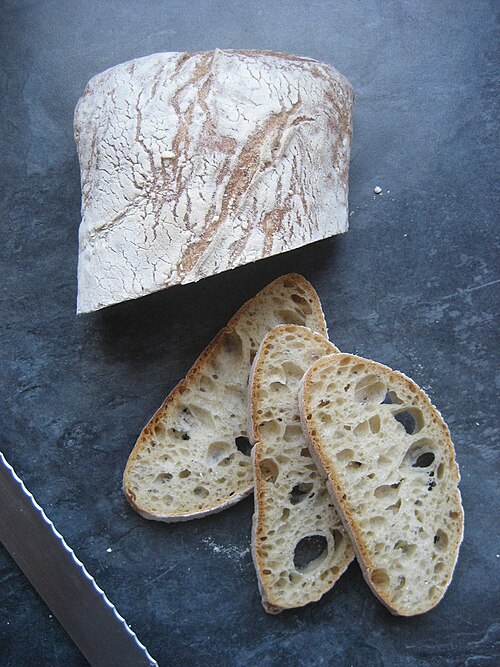
Ciabatta is an Italian white bread made with wheat flour and yeast. The loaf is somewhat elongated, broad and flattish and, like a slipper, should be and somewhat collapsed in the middle. Since the late 1990s it has been popular across Europe and in the United States, and is widely used as a sandwich bread.

Ingredients

  • 350 g sifted wheat flour
  • 280 g lukewarm water
  • 1 tsp salt
  • 38 g olive oil (optional)
  • 1 tsp active dry yeast

Steps

  1. Dissolve salt and yeast in lukewarm water.
  2. Add sifted wheat flour and olive oil. Mix.
  3. Mix until the dough is uniform in texture and consistency. Cover. Rest in a warm place 45 minutes.
  4. Stretch the dough and fold it over itself on all four corners, adding flour to the surface to prevent sticking. Cover. Rest about 30 minutes, until risen.
  5. Repeat stretching and folding on all sides to form air pockets. Cover. Rest 30 minutes.
  6. Repeat once more. Cover. Rest 30 minutes.
  7. Place dough on a baking sheet. Cut into equal parts to form smaller, elongated loaves.
  8. Bake in preheated oven at 430 F for 18 minutes.

Notes from the original

  • Before closing oven, mist the bread dough with a spray bottle to ensure a crusty top.
  • Some doughs used for making Ciabatta bread were left to ferment 18–24 hours before being worked; the batch of dough then being refreshed with the addition of water, malt, and salt, after which it was again allowed to sit without agitation so that it could rise.

Source. Adapted from “Cookbook:Ciabatta” by Wikibooks contributors, revision of 2025-07-15, licensed under CC BY-SA 4.0.

Changes. Steps rewritten into short commands. Introduction shortened. Wiki formatting removed. This adapted recipe is shared under CC BY-SA 4.0.

Photo. Ciabatta cut.JPG by Vincent Talleu, CC BY-SA 3.0, via Wikimedia. Resized; otherwise unchanged.