


Pesto II
Difficulty 1/5 Ingredients 5 Steps 7
Pesto is a sauce which is added mainly, but by no means exclusively to pasta. Pesto is purely the Italian version of this delicious sauce, with other names for the same (or similar) sauce from other countries. Another famous national variant to pesto is pistou, which is the French equivalent.
Ingredients
- High-quality olive oil
- 1 packet of pine nuts or walnuts
- 2 large plants worth of fresh basil
- 7 garlic cloves
- Freshly grated Parmesan cheese (not Pecorino)
Steps
- Use electric blender or liquidiser.
- Put a good quantity of olive oil in blender first. Start it running, so blades do not gum up and basil does not burn.
- Drop basil leaves through top into oil to mulch.
- Add some nuts to mulch.
- When pesto sticks and thickens, add more olive oil until it mulches again. Continue adding basil leaves, nuts and garlic cloves, keeping mixture fluid.
- When basil and nuts run low, add a handful of Parmesan cheese, not too much; taste should be mostly basil.
- Empty into its own container.
Notes from the original
- If you like your pesto a little rough, add a small extra quantity of pine nuts and some grated Parmesan cheese to the finished pesto and mix in well. You're ready to go.
- Fresh pesto can be stirred into pasta (penne in a good choice), added as a topping to crostini, or eaten, with eyes closed and a smile on your face, off a spoon, entirely on its own.
- Greek olive oil is actually better for this recipe than either French or Italian as it has a stronger taste.
- Pine nuts give the pesto a blander flavour, walnuts a more robust flavour.
Source. Adapted from “Cookbook:Pesto II” by Wikibooks contributors, revision of 2025-06-21, licensed under CC BY-SA 4.0.
Changes. Steps rewritten into short commands. Introduction shortened. Wiki formatting removed. This adapted recipe is shared under CC BY-SA 4.0.
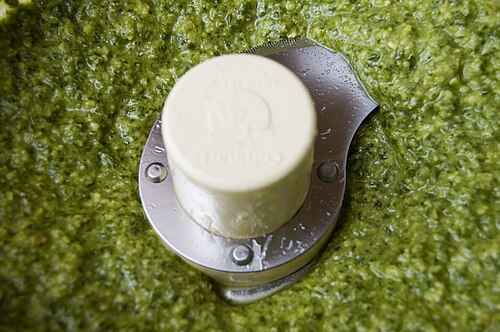
Photo. Pesto being processed.jpg by Paul Goyette, CC BY-SA 2.0, via Wikimedia. Resized; otherwise unchanged.