

Roast Potatoes
Difficulty 3/5 Ingredients 4 Steps 19
Roast potatoes (also known colloquially as 'roasties') are usually used as the prime starch accompaniment to a roast dinner, which is usually made up of a roast meat and several different vegetables. Some people, however, prefer to make and eat them by themselves or with other pairings.
Ingredients
- Potatoes
- Oil, fat (goose or duck), or lard
- Salt (optional)
- Water
Steps
- Preheat oven to 220°C (425°F, gas mark 7).
- Peel potatoes. Cut into quarters or eighths. Smaller pieces give crispier potatoes, larger softer.
- Put potatoes in saucepan of water. Add pinch of salt if desired.
- Cover. Bring to boil. Simmer 10 minutes to parboil.
- Drain with slotted spoon or metal colander.
- Replace lid. Shake vigorously 20–30 seconds.
- Coat potatoes lightly with oil or fat. Place in tin. Use a deep tin; shallow tins tip and spill oil.
- Sprinkle salt over potatoes.
- Roast 20–50 minutes, until golden brown.
- Remove from oven. Excess oil is hot and can burn. Cool potatoes to 30–40°C in oven before removing, or pull tray partly out and remove potatoes individually with tongs or metal spoon.
- Serve hot. Keep warm in oven, without piling up.
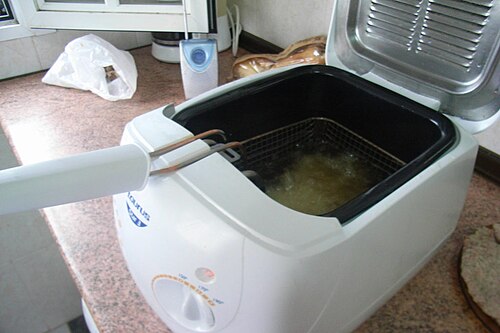
Deep fryer
- Parboil potatoes as above. Drain and dry to avoid splatter in hot oil.
- Deep fry potatoes briefly.
- Transfer to oven. Roast as above.
Tray-frying
- Preheat oil in deep tray in oven.
- Parboil potatoes as above. Drain and dry to avoid splatter in hot oil.
- Keep tray in oven. Wearing oven mitt, pull rack out slightly to access hot oil, standing behind oven door.
- Transfer potatoes individually into tray with tongs, rotating to coat in oil. Or baste with metal spoon; they sizzle. Tipping potatoes from saucepan into tin risks splashing.
- Transfer to oven. Roast as above.
Notes from the original
- Times and quantities are rough and can vary to suit individual tastes.
- The roughing up of the surface of the potatoes is key to a crispy surface—this is the purpose of the shaking, and it can alternatively or additionally be accomplished by scraping the surface of the potatoes with a fork. Compare with forking the top of the mash in shepherd's pie.
- If initially deep-frying, the fat or oil must be hot before adding the potatoes—they should sizzle when added—or else they will be greasy rather than fluffy and crisp.
- Some advocate flipping the potatoes half-way through roasting, while others assert that this is unnecessary. You may also wish to carefully baste with oil partway through the roast, to ensure an even coating; again, some find this necessary, while others do not.
- Potatoes can also be cooked in the same oven and same roasting tin as the meat or other vegetables if being included as part of a roast dinner; they should go in half an hour before the meal is to be served.
- Note that the roast and other dishes may require or benefit from different cooking than the potatoes—both different temperature and different time—and hence it may be easier to cook them separately, or at least to take these differences into account. Using the fat from the roast requires a significant amount of fat on the roast and room in the tray—you will often find that cooking separately or with additional fat or oil is better.
Source. Adapted from “Cookbook:Roast Potatoes” by Wikibooks contributors, revision of 2025-05-26, licensed under CC BY-SA 4.0.
Changes. Steps rewritten into short commands. Introduction shortened. Wiki formatting removed. This adapted recipe is shared under CC BY-SA 4.0.
Photo. Freidora.jpg by Dr Juzam, Public domain, via Wikimedia. Resized; otherwise unchanged.